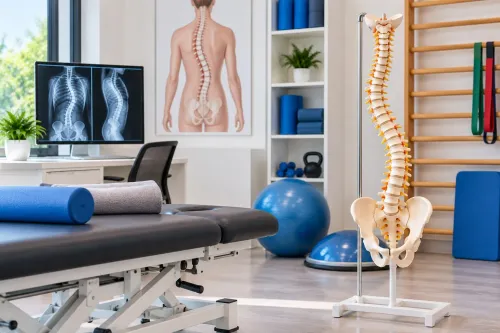



Yes, but useful postural care begins with confirming what is happening in the spine and identifying whether symptoms are stable, progressing or linked to another problem. You will be able to choose the right clinician, prepare for a first appointment and judge whether a proposed programme offers practical movement support rather than promises to straighten a mature spine.
Key takeaways
- Ask whether imaging is clinically indicated and how the Cobb angle will be measured.
- Choose care based on your curve, symptoms, movement limits and need for medical follow-up.
- Track pain, function, posture and exercise tolerance—not appearance alone.
- Escalate new weakness, numbness, bladder changes or rapidly worsening pain promptly.
What postural care should assess in a young adult with scoliosis
A proper assessment does more than label your shoulders uneven: it checks whether scoliosis is structural, how it affects movement, and what needs medical follow-up. A visual posture check cannot measure curve size; structural scoliosis is measured with the Cobb method on a standing spinal radiograph when imaging is clinically indicated.
- Your curve history, previous X-rays, pain pattern and physical activity, including whether symptoms or the curve appear to be changing.
- Standing alignment, pelvic position, limb-length differences, shoulder height, rib prominence and trunk rotation.
- Gait, balance, spinal movement, muscle control and the positions that increase or reduce symptoms.
- Breathing mechanics, especially if rib or trunk asymmetry limits chest expansion.
- Neurological symptoms, including weakness, numbness or altered reflexes, which need more than a posture programme.
Good postural care in Pune can improve movement habits, body awareness, strength, endurance and pain-related function. It cannot reliably straighten a structural curve by teaching you to sit or stand “straight,” and exercise should not be sold as guaranteed curve correction.
Seek prompt medical review rather than routine posture classes if you develop new weakness or numbness, bowel or bladder changes, severe night pain, fever, unexplained weight loss or rapidly worsening symptoms. A coordinated assessment can show whether physiotherapy-led care is reasonable and when a spine or orthopaedic review is needed.
How your first scoliosis assessment in Pune usually works
Your first appointment should establish whether you have a structural spinal curve, a movement-related problem, or both. Young adult scoliosis care in Pune should connect a spine or orthopaedic assessment with physiotherapy planning rather than rely on posture photographs alone.
- The clinician records when the curve was identified, previous treatments, pain behaviour, activity limits and any earlier scans.
- They inspect shoulder, rib and pelvic asymmetry, spinal alignment, breathing mechanics and leg-length differences.
- They assess gait, balance, trunk movement, strength, flexibility and neurological signs such as altered sensation or weakness.
- They discuss your goals, including exercise, work tolerance, sport participation and pain management.
Bring previous reports and image files, not just the written report. A standing whole-spine X-ray is useful when the clinician needs to measure the Cobb angle, assess pelvic balance, or compare a curve with earlier images. It is not required at every visit if recent suitable imaging already answers those questions.
MRI is reserved for specific concerns, such as neurological findings, unusual or severe pain, suspected disc or spinal-cord disease, or a curve pattern that needs further investigation. New weakness, numbness, bowel or bladder changes, fever, unexplained weight loss, severe night pain or rapidly worsening symptoms require prompt medical review rather than a routine posture session.
Choosing between physiotherapy, orthopaedic and spine care
A spine or orthopaedic clinician should assess a young adult’s scoliosis when the diagnosis is uncertain, previous scans are unavailable, pain is increasing, or the curve’s stability is unknown. That assessment should review the Cobb angle on standing spinal X-rays when clinically indicated, along with neurological findings and the curve’s history.
| Care route | Main role | When it fits |
|---|---|---|
| Spine or orthopaedic clinician | Confirm the curve, review standing imaging and assess progression or structural causes | First assessment, worsening pain, uncertain diagnosis or neurological symptoms |
| Physiotherapy-led programme | Build strength, movement control, balance, breathing mechanics and activity tolerance | Stable assessment with goals such as pain reduction, better function or return to sport |
| Spine-surgery review | Consider complex structural problems, neurological compromise or selected progressive curves | New weakness, numbness, bowel or bladder changes, or rapid deterioration |
A physiotherapy-led programme is appropriate after medical assessment has identified a stable curve and no finding requires urgent escalation. Ask whether the physiotherapist has scoliosis-specific training; a generic back-pain routine does not automatically address a three-dimensional spinal curve.
A scoliosis clinic in Pune is worth comparing by its process, not its label. Ask who measures the Cobb angle, whether standing whole-spine imaging is arranged when needed, how progress will be recorded, and who reviews you if symptoms worsen.
Fever, severe night pain, unexplained weight loss or rapidly increasing symptoms require prompt medical review rather than posture classes.
What treatment, home practice and progress checks involve
A non-operative plan combines symptom management with individually prescribed exercise; it does not promise to straighten an established structural curve. For a stable curve and manageable symptoms, surgery is not usually first-line care.
Bracing in a skeletally mature young adult is reserved for selected painful or progressive curves under specialist supervision because skin problems, poor tolerance and deconditioning can outweigh limited structural benefit.
Your physiotherapist may build the programme around:
- scoliosis-specific trunk and hip exercises matched to your curve and movement pattern
- breathing or rib-mobility work if stiffness or reduced expansion limits activity
- balance, gait and body-awareness training
- graded return to sport, lifting or prolonged sitting
- practical changes to pacing, workstation setup and recovery
Home practice requires consistency rather than occasional intensive sessions. Expect short prescribed sessions on most days, plus movement and pacing strategies during work, study or sport; plan around pain, fatigue and travel instead of ignoring them.
Progress checks compare pain, walking, sitting tolerance, strength, balance, breathing and sport capacity—not just photographs. Repeat standing spinal X-rays and Cobb-angle measurements help confirm progression when it is suspected, not at every visit.
Postural care in Pune and young adult scoliosis care in Pune should improve comfort, endurance, control and confidence; they cannot reliably reverse spinal anatomy. New weakness, numbness or rapidly worsening symptoms needs medical review.
How to compare scoliosis services in Pune and know when to escalate
A credible scoliosis clinic in Pune can tell you who measures your Cobb angle, whether standing whole-spine imaging is indicated, and who reviews worsening symptoms. Ask these questions before booking a package built around posture photographs or promises of permanent curve correction.
| Question to ask | A useful answer | Warning sign |
|---|---|---|
| Who measures the curve? | A spine or orthopaedic clinician interprets standing images and records the Cobb angle. | No measurement beyond photographs |
| How will progress be checked? | Pain, function, balance, activity and repeat imaging when clinically justified. | “Before-and-after” posture pictures only |
| Who leads exercise? | A physiotherapist with scoliosis-specific training works from the clinical findings. | A generic routine for every curve |
| What happens if symptoms worsen? | The provider has a named medical or spinal referral pathway. | No escalation plan |
Young adult scoliosis care in Pune should include a review of curve history, previous scans, gait, neurological symptoms, breathing limits and activity goals. Pro Active Clinic is worth assessing by whether it can coordinate standing spinal review and onward referral, not simply by its service label.
Seek prompt medical review for new weakness, numbness, bowel or bladder changes, severe night pain, fever, unexplained weight loss or rapidly worsening symptoms. Contact a spine surgeon when imaging documents progression, pain remains disabling despite non-operative care, major imbalance develops, or neurological or cardiopulmonary function is substantially affected. Surgery is not a routine posture correction.
Related service
Scoliosis and Postural Care Scoliosis Care for Young Adults At Pro Active Clinic, we provide scoliosis-focused care for young adults with an abnormal sideways curvature of the spine. |
Frequently asked questions
What should postural care assess in a young adult with scoliosis?
It should assess spinal alignment, whether the curve appears structural, movement, pain, balance, breathing limits and signs that need medical follow-up. A visual check cannot measure curve size; a standing spinal radiograph and Cobb angle measurement are used when imaging is clinically indicated.
What happens during a first scoliosis assessment in Pune?
The clinician usually reviews your history, symptoms, activity limits and previous reports, then observes posture, walking, spinal movement, strength and balance. Ask what the assessment found, whether you need imaging or referral, and how progress will be measured.
Should I choose physiotherapy, orthopaedic care or spine care?
Physiotherapy focuses on movement, strength, symptom management and personalised exercise. An orthopaedic or spine specialist evaluates structural concerns, imaging and medical treatment. Choose a service that can coordinate referral when your symptoms or assessment require it.
When should I escalate scoliosis care?
Seek prompt medical review for new or worsening weakness, numbness, loss of coordination, bowel or bladder changes, severe night pain, breathing difficulty or rapidly worsening symptoms. Escalate when progress stalls despite following the agreed plan.